Shyspace vs Element
Element and Shyspace are both open source and end-to-end encrypted. They differ most on the server: Element needs one, a Matrix homeserver, and Shyspace has none.
Facts checked on
The short version
Choose Element if you need phone apps, video calls, or to talk with people in other organisations. Element is built on Matrix, an open network with bridges to other chat systems. It's also far more proven: governments run it, and its encryption has been audited.
Choose Shyspace if you want encrypted team chat with no server to run or rent, and documents in the same app.
| Element | Shyspace | |
|---|---|---|
| End-to-end encrypted | Partly:Private rooms by default. Public rooms are not | Good:Everything |
| Server | Partly:A Matrix homeserver: matrix.org's, or one you host | Good:None. Only a storage bucket you own |
| What the host can see | Partly:Room names, topics and who is in each room | Partly:Who writes, how much and when |
| Talking to other organisations | Good:Yes: federation, and bridges to other chat apps | No:No. A workspace is for the people you invite |
| Phone apps | Good:Yes | No:Not yet |
| Calls | Good:Voice and video | Partly:Voice |
| Documents | No:Not built in | Good:Pages, built in |
| Search in encrypted chats | Partly:In the desktop app only | Good:Yes, on your device |
| Track record | Good:Years in use, large deployments, audited encryption | No:New, not audited yet |
| Licence | Good:AGPL-3.0, or a paid licence | Good:AGPL-3.0 |
Where it runs
Every Element account lives on a Matrix homeserver, so a team has to pick one:
- Use matrix.org. Accounts are free, with upload limits: 10 MB per file and 100 MB a day. Your team's rooms then sit on a server run by someone else.
- Host your own. The server software is open source. Element's free Community edition is for up to 100 users and, in Element's words, for "non-professional deployments and evaluations". The paid edition is priced per seat, from 100 users. Either way, someone has to install the server, update it, back it up and keep it secure.
Shyspace has no server software at all. Devices that are online sync directly with each other, and a device that was away catches up from a storage bucket, which can be any S3-compatible one. A bucket only stores files, so there's nothing to install or update, and setting one up takes 15 to 30 minutes.
What the host can see
In Element's encrypted rooms, the server can't read what people write, but it still learns a good deal. As Element explained in 2025, a room's name, topic, picture and member list are stored "on the homeserver in plaintext", and hiding them is still an experiment. Public rooms aren't encrypted at all.
If you host the server yourself, the host is you, and for many teams that settles it. It matters more when someone else runs the server.
Shyspace's bucket only ever holds sealed data: its provider sees who writes, how much and when, but none of the content.
What Element does that Shyspace can't
- Element X runs on iOS and Android. Shyspace is a desktop app for now.
- You can talk beyond your team: Matrix servers talk to each other, and bridges connect to Slack, Discord, WhatsApp, Signal, Telegram, IRC and more.
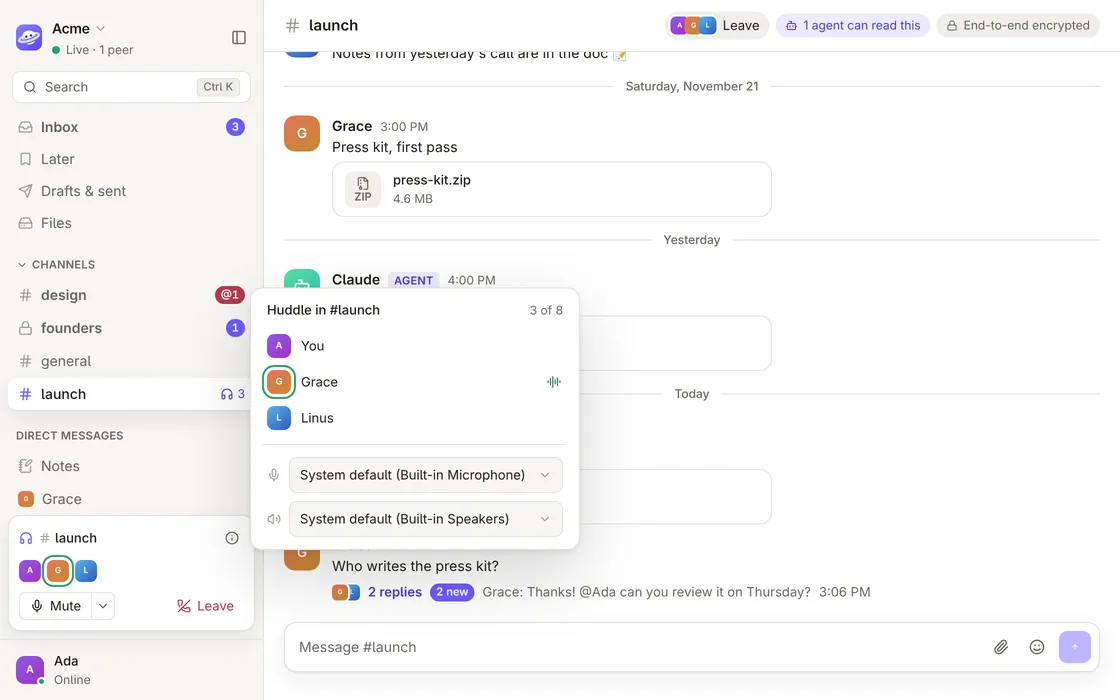
- Element Call does end-to-end encrypted voice and video calls. Shyspace's huddles are voice only.
- It has a track record. Element names governments and armed forces among its customers. Its encryption library had an independent public audit in 2022. Shyspace is at version 0.1 and hasn't had one.
What Shyspace does differently
- There's no server, so nobody on the team has to run one, and there's none to break into.
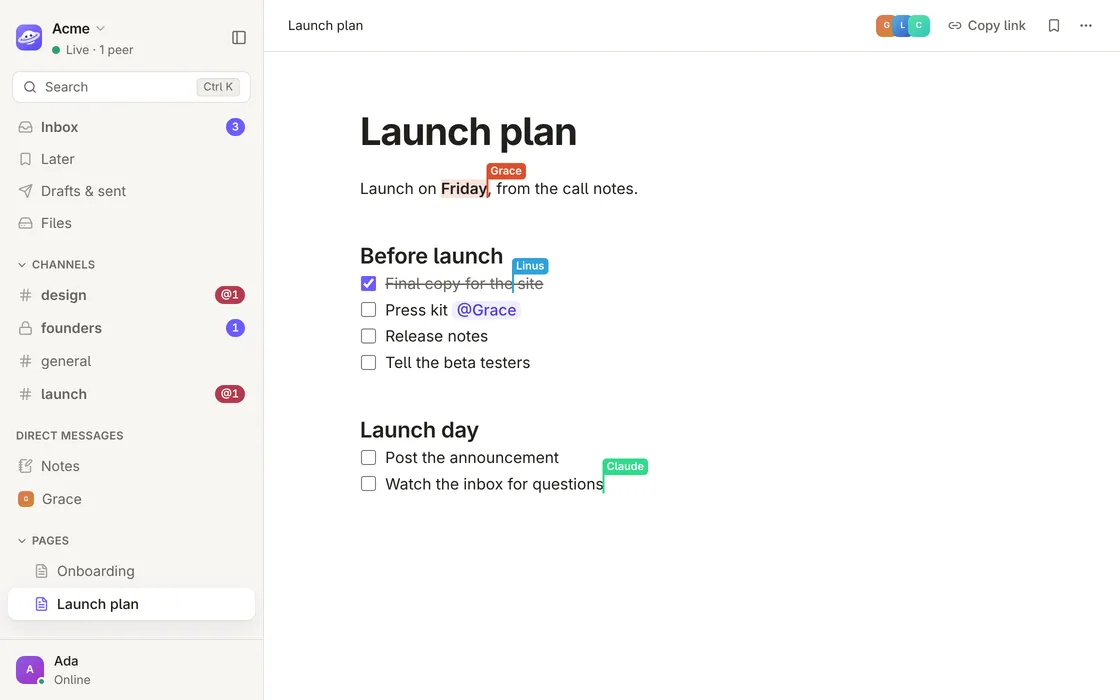
- Pages are documents that several people edit at once, next to the conversations they come from, and they're encrypted like everything else.
- Everything is stored on your device, so search covers all of it. Element's help page says search in encrypted rooms "only works on Desktop".
- You can read and write without a connection, and changes sync when you're back.
Shyspace's limits
Besides the gaps above: a workspace has one admin, and every member's app holds the bucket's keys, so a member could delete data unless the bucket is set up to keep it. The app checks this and warns you. The security doc has the full list.
Which one should you choose?
Choose Element if you need phones or video, if you talk with people outside your team, or if you need software that large organisations have already tested. Someone will have to run a homeserver, or you trust the one you join.
Choose Shyspace if your team works on computers and you'd like the same privacy without a server, with your documents in the same place as your chat.
Sources
- Element blog: End-to-end encryption by default (May 2020)
- Element blog: Hiding room metadata from servers (September 2025)
- Matrix.org: Homeserver plans
- Element: Pricing
- Matrix.org: Bridges
- Element Call
- Element Web: licence
- Element: Customers
- Matrix.org: Independent public audit of vodozemac (May 2022)
- Element: Help
- Shyspace: Security